
STAR-MEALS — Unlocking the Future of Space Gastronomy
STAR-MEALS Gastronomy Pod — module cut-away
STAR MEALS

Space Gastronomy : Unlocking the Future

The STAR-MEALS project is an innovative space gastronomy initiative that goes beyond mere nutritional replenishment — aiming to create a dining experience that brings joy and human connection to space. A project from Yamagata University, redesigning eating for the space era through food preservation, preparation, dining experiences, and circular food systems.

01 — Vision
STAR MEALS

Gastronomy Pod

A Future Dining Module for Space

The Gastronomy Pod integrates three zones within a single 16-metre module — Storage (production & preservation) at the rear, Kitchen (cooking) in the centre, and Dining (the dining experience) at the front. It is designed to create a seamless flow from ingredients to the final dining experience along a single axis.

FrontDining
→
CentreKitchen
→
RearStorage
Connection to Other Modules
Envisioned as an orbital restaurant docking with the ISS and commercial space-station ports.
Gastronomy Pod — module cut-away diagram
View from the Cupola
A forward observation window lets guests dine before the blue Earth and the vastness of space.
Front of Module · Zone 01 STAR MEALS

Dining

A Wa-Modern Communal Space with an Earth View

Dining zone — Wa-Modern communal space with Earth-view cupola 1
1
Avatar Chef
Recreates the warm voice and refined gestures of renowned chefs on Earth — reading diners’ pace to personalise nutrition and seasoning.

Located at the very front of the module, the dining area is a space of profound tranquillity — a “Wa-Modern” aesthetic crafted from natural materials such as wood and traditional washi paper, with tatami lining the entire floor. The tatami brings a deep sense of calm, creating a comforting oasis in the zero-gravity environment of space. At the central round table, tableware is secured with magnetic mechanisms and clear covers; this meticulous crumb-free / spill-free design lets guests dine with graceful elegance. Seats equipped with HMDs further offer a “remote communal dining” experience, sharing a meal with family and friends on Earth through avatars.

Centre of Module · Zone 02 STAR MEALS

Kitchen

Zero-G Automated Robotic Kitchen : Bringing Food to Life with 3D / 4D Printing

Kitchen zone — zero-gravity robotic culinary theatre 1 2 3
1
Laser-Type 3D Printers
Localised laser heating generates distinct textures and precisely controlled browning.
2
Submerged-Type (In-Liquid)
Food ink extruded into a liquid medium — sharp, splatter-free edges and soft liquid desserts.
3
Nozzle-Type (Screw & Inkjet)
Precisely extrudes paste-like ingredients to craft beautifully shaped dishes such as sushi.

At the centre of the module, the kitchen is a fully automated culinary theatre operated by articulated robotic arms and a ceiling-mounted rail system. Its defining feature is specialised 3D and 4D food-printing technology: going far beyond reconstructing powders into shapes, 4D printing uses stimuli-responsive edible materials that change shape, texture and aroma in response to temperature and moisture — a dish that releases a sudden burst of aroma and visibly quivers like freshly prepared ikizukuri right before your eyes. To achieve this safely in zero gravity, all cooking takes place within enclosed “sealed transparent cells,” maintaining cleanliness standards akin to a semiconductor cleanroom.

Rear of Module · Zone 03 STAR MEALS

Storage

Orbital Food Source : A Closed-Loop Ecosystem with Innovative Cryogenic Technology

Storage zone — Cryo Vault with high-density cartridges below −120°C 1
1
Preservation at −120°C
The Cryo Vault sits at the very rear; ingredients are cryogenically milled below −120°C for stable long-term preservation on extended missions.

At the heart of the storage area lies COOLD FOOD — cryogenically milled hydrated gel-powder technology that powderises fresh and pre-cooked ingredients for long-term preservation while maintaining flavour and texture. Far from a simple warehouse, it functions as a closed-loop system for food production and preservation, integrating high-density cartridge storage alongside orbital vertical farms and water reclamation. The preserved cartridges seamlessly supply the adjacent kitchen, serving as the direct material inputs for the specialised 3D and 4D food printers.

02 — In Progress
STAR MEALS

Vision in Motion

— Projects Currently in Progress —

“Eating Well, in Space and on Earth.”

Designing the Future of Food Culture from Space

For long-duration missions, food is positioned not merely as nutrition but as a foundation for joy, satisfaction, and physical and mental well-being. STAR-MEALS establishes systems for preservation, reconstruction, preparation, serving and evaluation in closed environments — and the technologies it develops, from food preservation and 3D/4D printing to texture, aroma and nutrition design, are applied back on Earth to nursing-care foods, disaster foods, regional food industries, and high-value-added food services.

STAR-MEALS in progress — dishes, food-printing equipment and the team at work
From printed sushi and fine dining to the food printers and the team behind them — the project in motion, today.
Research & Technologies

Technologies Under Development

3D/4D food printer family — AIRCOOK, LASERCOOK, JETCOOK
Tech 01

3D / 4D Food Printers

A diverse lineup of food-printing technologies

From the FP-2500 (2015) to AIRCOOK, LASERCOOK and JETCOOK, STAR-MEALS develops a family of printers that digitally control dispensing, shaping, heating, solidifying and finishing — a new food manufacturing platform for use both in space and on Earth.
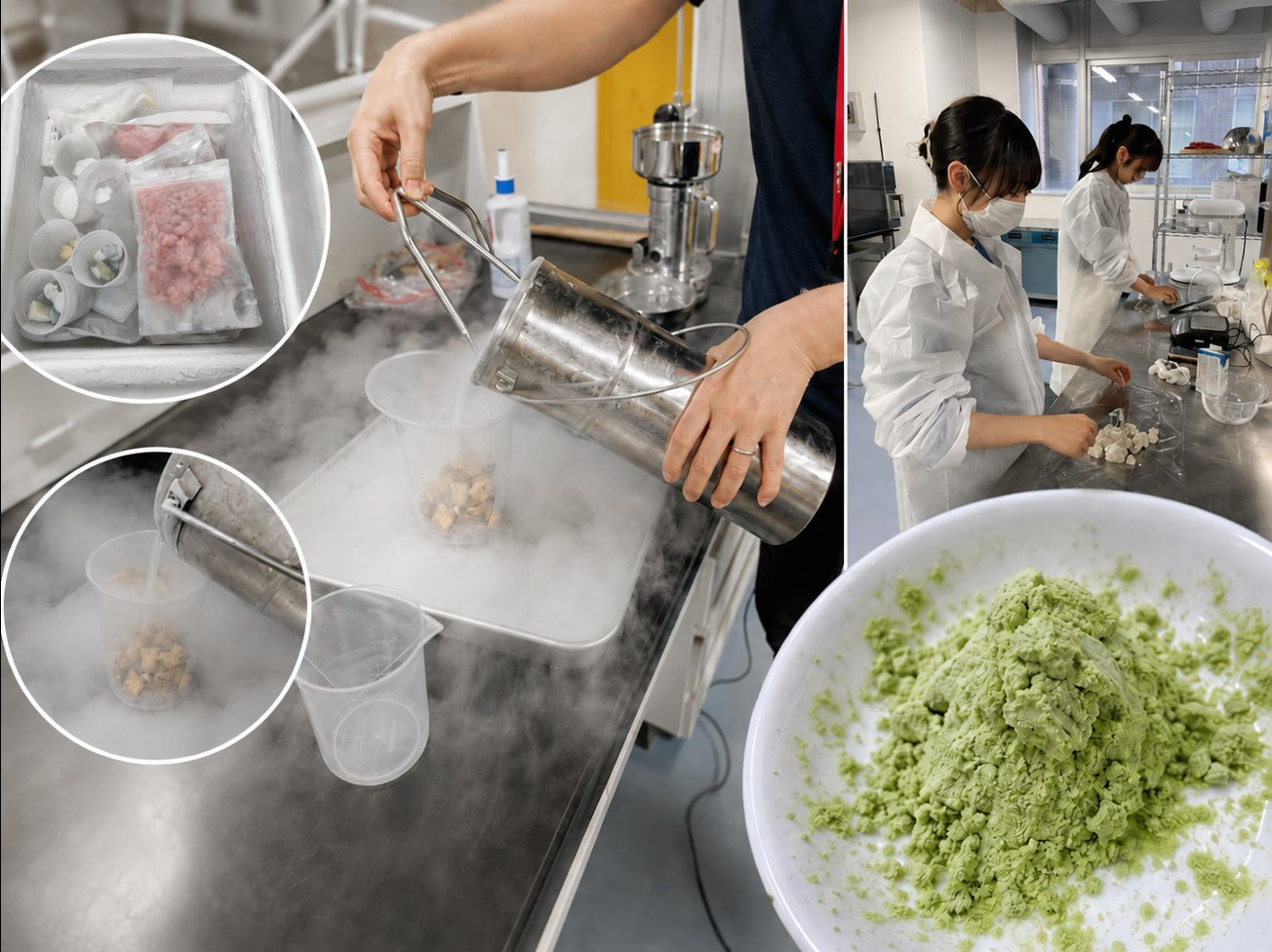
COOLD FOOD — cryogenic milling research
Tech 02

COOLD FOOD

Cryogenically milled hydrated gel powder

Developed through the Moonshot programme, COOLD FOOD uses low-temperature frozen milled hydrogel powders to enable long-term preservation and to reconstruct texture, shape and nutrition through 3D food printing — the core of the orbital food source.

Digital Restaurant — personalised dining experience
Tech 03

Digital Restaurant

Advanced under SIP Phase 3

A Digital Restaurant System pairing texture-analysis AI, 3D printers and the Interverse to design personalised dining — combined with COOLD FOOD to form a future cooking system that serves both space crews and care, disaster and regional food needs on Earth.

Consortium

Implementing Organizations

  • Yamagata University
  • Kyushu University
  • The Ritsumeikan Trust
  • Yamagata Research Institute of Technology
  • Ichimasa Kamaboko Co., Ltd.
  • Watami Farm Co., Ltd.
  • Fuji Oil Co., Ltd.
  • F-EAT Inc.

※ Bold indicates the representative organization.

Advanced as part of SX-CRANE, a JAXA Space Strategy Fund project for space technology transfer and the creation of new industrial seeds — uniting food companies, chefs, restaurants, designers, robotics and AI researchers, standardisation specialists and space organisations to help create a new food industry for the space age.

Roadmap

From Earth to Space

Tengendai Alpine Lab ground demonstration site
2026–29
Step 01 · Ground

Ground demonstrations at the Tengendai Alpine Lab and urban test sites.

Integrated validation facility interior
2030–33
Step 02 · Integration

Integrated validation of COOLD FOOD, 3D/4D food printing and digital restaurant systems.

2040 +
Step 03 · Orbit

Toward space dining with a Gastronomy Pod connected to a future space station.

Ground-facility renderings (2026–33) © Clouds Architecture Office